
When you’re facing a gynecologic surgery recommendation, the question you’re probably sitting with isn’t just “do I need this?” It’s “what does this actually involve, and is there a better way through it?”
That question deserves a straight answer.
Direct Answer
Laparoscopic and robotic-assisted surgeries are minimally invasive approaches that use small incisions, a camera, and specialized instruments instead of a large open cut. For most benign gynecologic conditions, they offer faster recovery, less blood loss, and lower complication rates than open surgery. But they’re not always the right choice, and understanding the tradeoffs is how you make a decision you’ll feel confident about.
Key Takeaways
- Minimally invasive surgery (laparoscopic or robotic) is appropriate for most benign gynecologic conditions including fibroids, endometriosis, ovarian cysts, and prolapse repair
- Open (abdominal) surgery is still the standard for certain complex cancers, very large uterine fibroids, and situations where anatomy is significantly distorted
- Robotic-assisted surgery adds precision and range of motion in complex cases but doesn’t automatically mean better outcomes than standard laparoscopy for straightforward procedures
- The “right” approach depends on your specific anatomy, diagnosis, surgical history, and surgeon’s skill set, not on which technique sounds most advanced
- A thorough pre-surgical consultation should explain your options, realistic recovery timelines, and what the surgeon expects to find, not just hand you a consent form
What Does “Minimally Invasive” Actually Mean in Gynecologic Surgery?
Minimally invasive surgery is a surgical approach that accesses the pelvis through small incisions (typically 5 to 12mm) using a camera and long instruments, rather than a single large abdominal opening.
There are two main types used in gynecology:
Laparoscopic surgery uses a thin camera (laparoscope) inserted through a small incision near the navel, with additional small incisions for instruments. The surgeon operates while watching a video monitor.
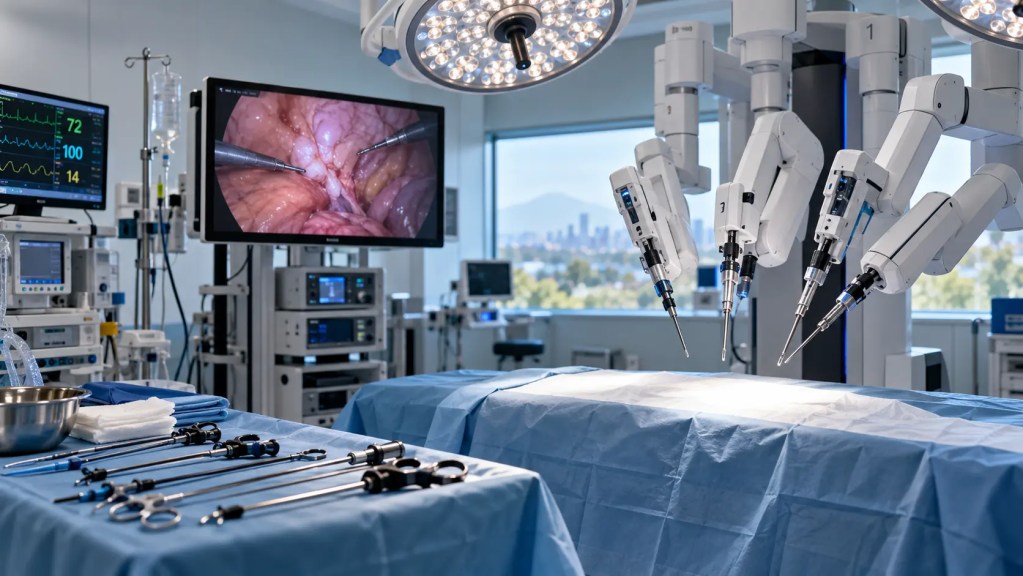
Robotic-assisted laparoscopic surgery uses the same small-incision approach, but the surgeon controls robotic arms from a console. The system translates the surgeon’s hand movements with greater precision and a wider range of motion than standard laparoscopy allows.
Both are performed under general anesthesia. Both go home the same day or the next morning for most procedures.
What they share is what matters most: smaller wounds mean less tissue trauma, which means faster healing, less postoperative pain, and a lower risk of infection compared to open surgery.
Which Conditions Are Best Suited for a Minimally Invasive Approach?
Most benign gynecologic conditions are good candidates. Here’s where the evidence is clearest:
Endometriosis. Laparoscopy is the gold standard for both diagnosing and treating endometriosis. It’s the only way to visually confirm the diagnosis and surgically remove lesions at the same time. Open surgery adds recovery time without adding diagnostic accuracy.
Ovarian cysts. Most benign ovarian cysts, including dermoids, endometriomas, and functional cysts that don’t resolve on their own, can be removed laparoscopically with ovarian tissue preservation.
Uterine fibroids (myomectomy). Laparoscopic or robotic myomectomy works well for many fibroids, particularly those that are pedunculated (on a stalk) or subserosal (on the outer wall). Robotic assistance is especially useful here because suturing inside the pelvis is technically demanding and the robotic system improves precision.
Hysterectomy. Minimally invasive hysterectomy (laparoscopic or robotic) is now preferred over open abdominal hysterectomy for benign indications. Recovery is typically two to four weeks instead of six to eight.
Pelvic organ prolapse repair. Robotic-assisted sacrocolpopexy, a procedure to lift and support the vaginal vault, is a case where robotic precision genuinely changes the procedure. The suturing angles required are difficult to achieve laparoscopically without robotic assistance.
Tubal ligation and ectopic pregnancy. Standard laparoscopy is the approach of choice.
When Is Open Surgery Still the Right Answer?
Open surgery isn’t a fallback for surgeons who haven’t learned newer techniques. It’s the appropriate choice in specific clinical situations, and pretending otherwise doesn’t serve you.
Very large uterine fibroids. When a uterus is significantly enlarged (roughly the size of a 16-week pregnancy or larger), the working space inside the abdomen becomes limited. Removing large fibroid tissue through small incisions also requires morcellation, which carries specific risks. Open surgery may be safer and more complete.
Gynecologic cancers. Staging and treatment of ovarian, uterine, or cervical cancer often requires open surgery to allow thorough lymph node sampling, assessment of surrounding structures, and complete tumor removal. Some early-stage uterine cancers are now managed laparoscopically or robotically, but this decision belongs with a gynecologic oncologist, not a general gynecologist.
Extensive pelvic adhesions. Prior surgeries, severe endometriosis, or pelvic inflammatory disease can create dense scar tissue that makes laparoscopic visualization unsafe. A surgeon who can’t see clearly can’t operate safely.
Emergencies. Ruptured ectopic pregnancies with significant internal bleeding, or other acute emergencies, may require immediate open access.
The honest truth about surgical decision-making: the best approach is the one your surgeon can do safely and completely, not the one with the smallest incisions.
The Comparison You Actually Need to See
| Situation | Minimally Invasive (Lap/Robotic) | Open (Abdominal) Surgery |
|---|---|---|
| Benign fibroid removal (moderate size) | Preferred; faster recovery | Used when fibroids are very large |
| Endometriosis diagnosis + treatment | Gold standard approach | Not indicated for diagnosis |
| Hysterectomy (benign cause) | Preferred; 2-4 week recovery typical | 6-8 week recovery; used when anatomy prevents MIS |
| Ovarian cyst removal | Preferred for most benign cysts | Used if malignancy suspected or cyst is very large |
| Gynecologic cancer staging | Case-by-case; oncologist decides | Often required for complete staging |
| Pelvic prolapse repair | Robotic approach preferred | Used when robotic not available or appropriate |
| Acute pelvic emergency | Laparoscopy if stable | Open if unstable or extensive bleeding |
The table above isn’t a recommendation for your specific case. It’s a framework for the conversation you should be having with your surgeon before you sign anything.
What Robotic Surgery Adds (and What It Doesn’t)
Robotic-assisted surgery is not a separate category of surgery. It’s a tool that helps surgeons perform laparoscopic surgery with greater precision in technically demanding cases.
The robotic system offers three things standard laparoscopy doesn’t: three-dimensional visualization, instruments that can rotate 360 degrees (human wrists can’t), and tremor filtration. For procedures requiring fine suturing deep in the pelvis, those advantages are real.
What robotic surgery doesn’t do: it doesn’t make an inexperienced surgeon experienced. The outcomes depend on the surgeon’s training and case volume, not on which console they’re sitting at. A skilled laparoscopic surgeon may achieve equivalent outcomes to a less-experienced robotic surgeon in straightforward cases.
The question to ask your surgeon isn’t “do you use the robot?” It’s “how many of these procedures have you done, and what’s your conversion rate to open surgery?”
What Recovery Actually Looks Like
For most laparoscopic or robotic procedures, you’ll go home the same day or the following morning. Most women return to desk work within one to two weeks and full activity within four to six weeks, depending on the procedure.
Open surgery typically means two to three nights in the hospital and a six-week recovery before returning to normal activity.
Pain after minimally invasive surgery is usually manageable with oral medications. Shoulder pain from the CO2 gas used to inflate the abdomen is common and resolves within a day or two. It’s uncomfortable and worth knowing about in advance.
One realistic note: “minimally invasive” refers to the incision size, not the complexity of what was done inside. A laparoscopic surgery for severe endometriosis can be a two-hour procedure with a more demanding recovery than a straightforward laparoscopic hysterectomy. Your recovery depends on what was actually done, not just how you got in.
If you’re weighing your surgical options and want to understand what the procedure would involve for your specific situation, the team at Synergy Women’s Health can walk through the clinical picture with you before you make any decisions.
Who Should Be Part of This Conversation Before Surgery
Surgery is a decision, not a prescription. You should understand what’s being proposed, why that approach over alternatives, what the surgeon expects to find, and what happens if the plan needs to change once they’re inside.
A typical pre-surgical consultation at a practice like Synergy Women’s Health includes a review of imaging, a discussion of your symptoms and history, and a clear explanation of what the procedure involves and what recovery will require. That’s not a luxury. That’s the minimum standard for informed consent.
Dr. Karen Ogryzlo, MD, co-owner and board-certified OB/GYN at Synergy, and Dr. Michelle Sang, who has been practicing women’s health since 1994, bring both surgical experience and the kind of unhurried conversation that lets you actually understand your options before you commit to anything.
If your surgical question also involves hormones, recovery support, or longer-term health management, Dr. Sang’s functional medicine program can address those layers in a way that standard pre-surgical consultations typically don’t.
This Isn’t the Right Path When…
Minimally invasive surgery isn’t appropriate as a first response to every pelvic symptom. Surgery of any kind carries risk, and the right first question is always whether surgery is necessary at all.
Conditions like small fibroids causing minimal symptoms, mild endometriosis, or ovarian cysts under a certain size are often managed medically first. Hormonal therapy, pain management, and watchful waiting are legitimate options that don’t involve an operating room.
The goal of a good surgical consultation isn’t to schedule a procedure. It’s to determine whether one is actually needed, and if so, which approach fits your anatomy, your diagnosis, and your recovery capacity.
If you’re in Portland and want a surgical consultation that starts with your full picture rather than a procedure recommendation, reach out to Synergy Women’s Health to schedule a visit. The conversation happens before the decision, not after.
Frequently Asked Questions
How do I know if my surgeon is recommending robotic surgery because it’s better for me or because it’s what they prefer?
Ask directly: “Is there a clinical reason robotic surgery is better for my specific case, or would standard laparoscopy achieve the same result?” A good surgeon will answer that question plainly. Robotic surgery adds genuine value in complex cases involving fine pelvic suturing, but for straightforward procedures, the outcomes between skilled laparoscopic and robotic surgeons are often comparable.
Will I need to stay in the hospital overnight after laparoscopic surgery?
Most laparoscopic gynecologic procedures are same-day or require one overnight stay. More complex procedures, or cases where unexpected findings require additional surgical time, may extend that. Your surgeon should give you a realistic expectation before the procedure, not a best-case scenario.
Can I get pregnant after laparoscopic surgery for endometriosis or fibroids?
In many cases, yes. Laparoscopic excision of endometriosis and myomectomy (fibroid removal) are specifically performed to preserve fertility in women who want to conceive. The impact on fertility depends on the extent of the disease, how much tissue was involved, and your baseline reproductive health. This is a conversation worth having with your surgeon before the procedure, not after.
What’s the difference between laparoscopic and robotic surgery in terms of what I’ll feel during recovery?
From a recovery standpoint, they’re very similar. Both use small incisions, both involve CO2 gas inflation of the abdomen (which causes temporary shoulder discomfort), and both typically allow a return to light activity within one to two weeks. The difference is in what the surgeon can do inside, not in how your body heals.
Is minimally invasive surgery covered by insurance for gynecologic conditions?
Most insurance plans cover laparoscopic and robotic-assisted gynecologic surgery when there’s a documented medical indication. Coverage depends on your specific plan, the diagnosis, and whether the procedure is considered medically necessary. Synergy Women’s Health accepts most major insurance and can help clarify coverage during your consultation.
What if my surgeon starts laparoscopically and then has to switch to open surgery?
This is called “conversion to laparotomy” and it happens in a small percentage of cases, usually because of unexpected findings, dense adhesions, or bleeding that can’t be safely managed through small incisions. It’s not a failure. It’s a surgeon making the right call in the moment. Ask your surgeon their conversion rate before the procedure so you have a realistic expectation.
How do I find a gynecologic surgeon in Portland who does minimally invasive surgery?
Board-certified OB/GYNs with specific training in minimally invasive gynecologic surgery (MIGS) are your best starting point. Ask about their case volume for your specific procedure, their conversion rate to open surgery, and whether they have privileges at a hospital with robotic surgical equipment. Synergy Women’s Health has been serving women in the Portland area since 2011 and can provide surgical consultations or refer to trusted surgical specialists when needed.
About the Author
Dr. Sang integrates traditional OB/GYN practice with functional medicine and regenerative therapies. Her care philosophy blends root-cause diagnostics with cutting-edge tools to help patients achieve long-term hormonal, metabolic, and immune balance. She is passionate about optimizing longevity and vitality at every age.
Education: Harvard University (BA), OHSU (MD)
Board Certified: OB/GYN & Anti-Aging Medicine
Special interests: hormone therapy, chronic condition management, peptide therapies